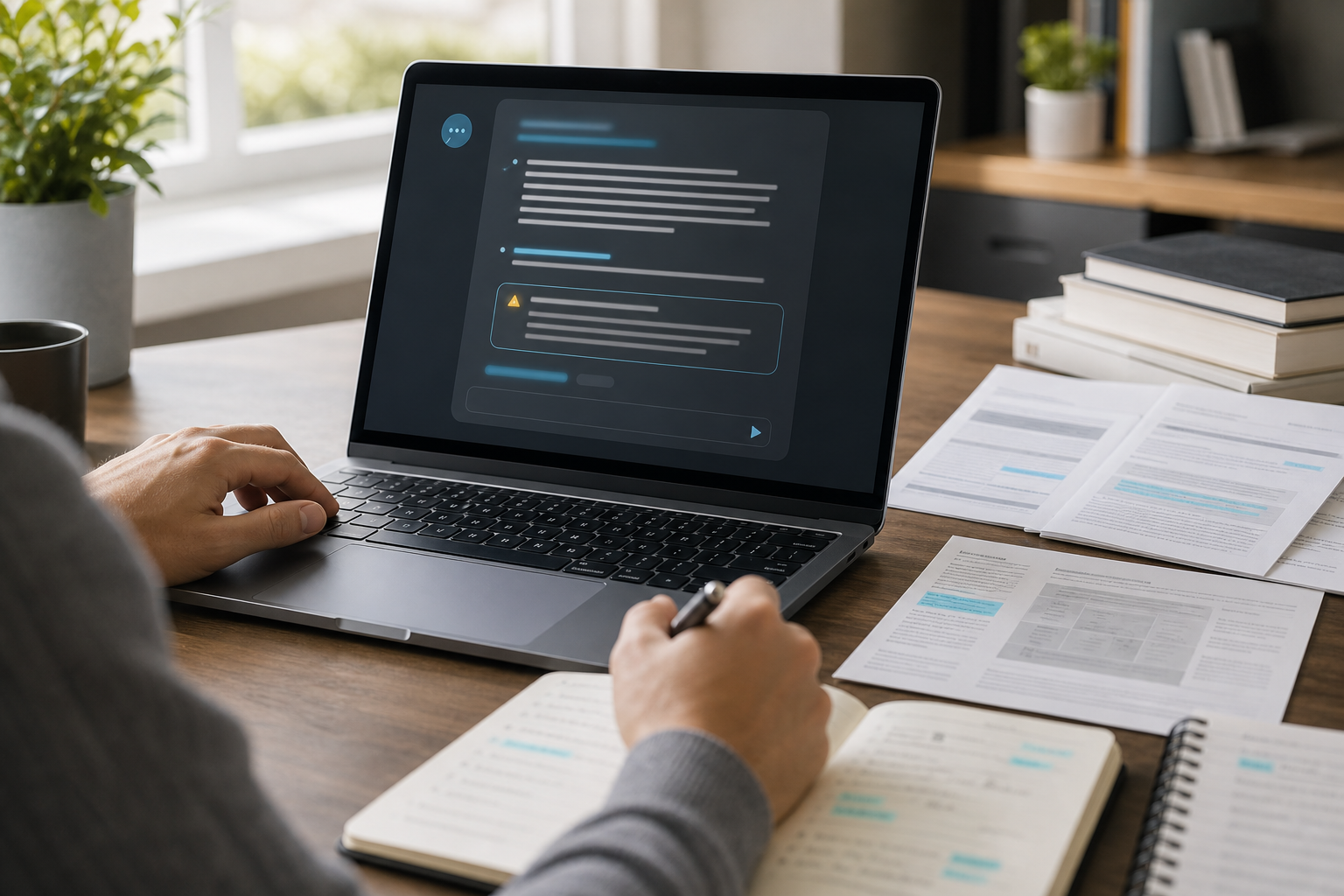
An AI assistant can write a smooth, confident answer even when the underlying information is wrong. These errors are commonly called hallucinations. The term can sound mysterious, but the basic reason is straightforward: a language model generates likely sequences of words. It does not automatically verify every statement against a trusted database.
Why plausible errors happen
Language models learn patterns from large collections of text. When asked a question, they use those patterns to produce a response that fits the request. This is useful for explanation and drafting, but it also means the model may fill a gap with something that sounds appropriate.
The risk increases when a question asks for an obscure fact, a precise quotation, a recent event, or information that was never available to the model. A request that assumes a false premise can also push the answer in the wrong direction.
Confidence is not evidence
Tone is one of the easiest traps. A detailed answer with dates, names, and technical language may feel authoritative, but presentation does not confirm accuracy. Even citations can be invented, incomplete, or attached to a claim they do not support.
Treat an AI answer as a helpful starting point, not as its own source. The higher the consequence of an error, the stronger the verification should be.
A practical verification routine
First, identify the claims that matter. General explanations may need a quick check, while medical, legal, financial, security, and safety guidance deserves authoritative sources and professional judgment.
Next, search for the claim independently. Prefer original documentation, official agencies, recognized standards, product manuals, or the research paper itself. Do not rely only on another page that repeats the same statement.
Check whether the source actually says what the AI claimed. A real link can still be irrelevant or outdated. Confirm dates, versions, geographic limits, and context. For quotations, locate the words in the original material.
Finally, compare more than one reliable source when the topic is disputed or changing quickly. If credible sources disagree, the answer should acknowledge that uncertainty instead of forcing a simple conclusion.
Prompts that reduce—but do not eliminate—errors
You can ask the assistant to distinguish known facts from assumptions, state what it cannot verify, and avoid inventing citations. Supplying a trusted document and asking questions about that document can also narrow the task. These techniques improve the result, but they do not replace checking.
AI is most useful when it helps organize a question, explain terminology, or create a first draft while a person remains responsible for the final facts. Verification is not a sign that the tool failed; it is the normal step that turns a plausible response into dependable work.