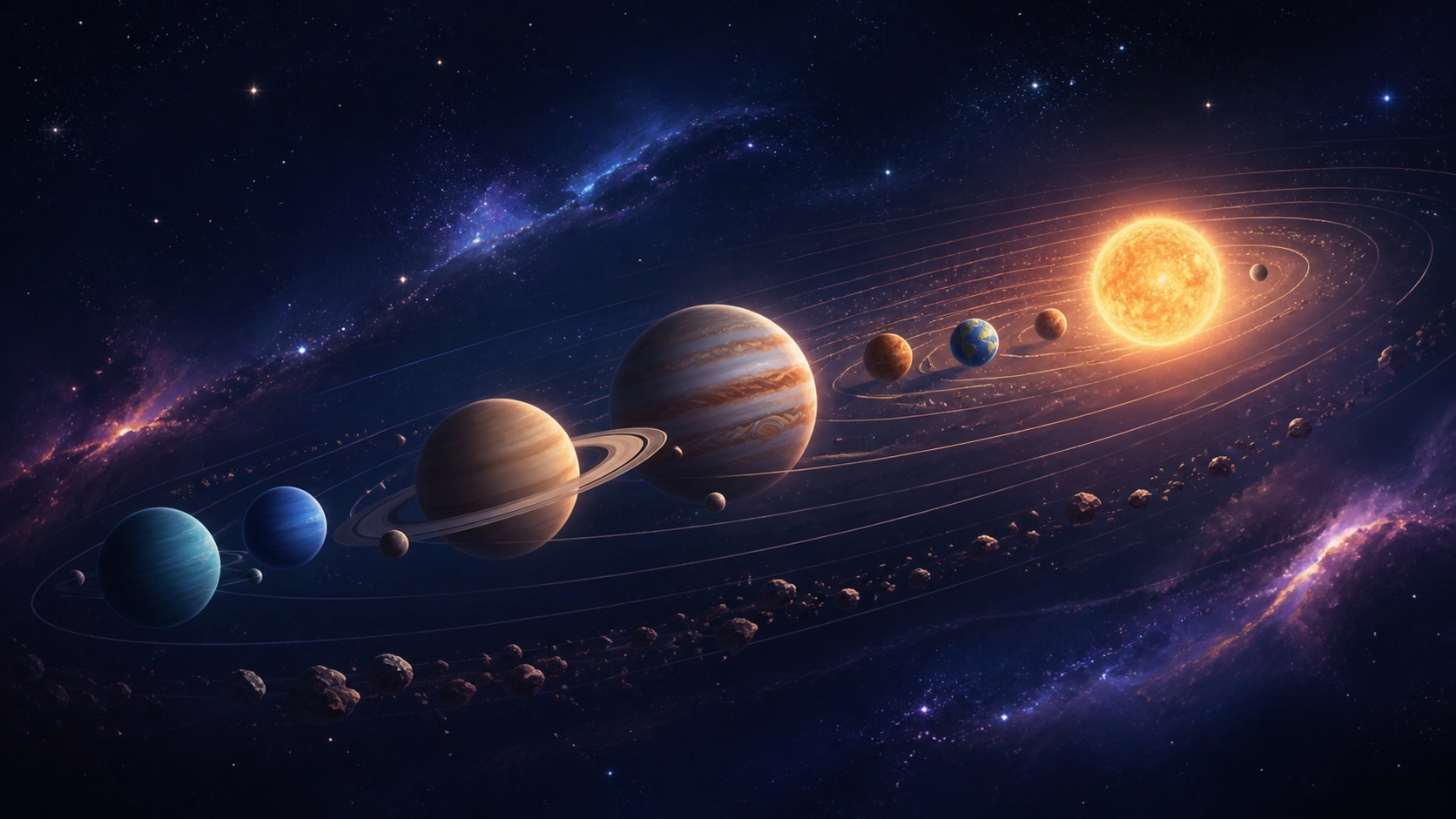
NASA offers a free educational poster collection about the solar system. The material brings together images and explanations designed to help students, families, teachers, and curious readers recognize the worlds that orbit the Sun. The collection works as a visual guide for beginning to explore our cosmic neighborhood without requiring specialized astronomy knowledge.
A collection for exploring our cosmic neighborhood
The set includes an overview of the solar system along with posters devoted to individual celestial bodies. Seeing the worlds together helps explain that planets are not isolated objects: they are part of a dynamic system that also includes the Sun, moons, asteroids, comets, and distant regions. Comparing them can make questions about their origins and environments easier to ask.
The Enséñame de Ciencia publication used as this article’s editorial source gathers the links for viewing or downloading the materials and explains how the collection is organized. MoonBytes Tech is publishing this original adaptation and linking directly to that publication so readers can consult the full context, download instructions, and attribution details.
What you can find
- An overview of the solar system, plus versions focused on the Sun.
- Posters about Mercury, Venus, Earth, Mars, Jupiter, Saturn, Uranus, Neptune, and Pluto.
- Material about the Moon, asteroids, Ceres, and comets.
- Resources about Io, Europa, Ganymede, Callisto, Titan, and Enceladus.
- Additional material that extends the conversation to objects and regions beyond the solar system.
Ways to use the material
The posters can support a classroom lesson, a family activity, or a science-communication project. A simple starting point is to choose two worlds and compare their size, composition, temperature, atmosphere, and distance from the Sun. Readers can then investigate which spacecraft have visited them, which instruments made those studies possible, and which questions remain open.
It is also useful to look closely at the visual language of each poster. Colors, diagrams, and scale comparisons turn abstract data into relationships that are easier to remember, but they do not replace scientific measurements. For precise figures, definitions, or current mission information, readers should pair the visual material with institutional sources and updated mission pages.
The collection can inspire hands-on science activities: building a scale model, ordering planets by distance, distinguishing planets from dwarf planets and smaller bodies, or researching why some moons have volcanoes, ice, or atmospheres. Its main value is to open a path toward exploration rather than reduce astronomy to a list of names.
One useful exercise is to ask students to write a question after viewing each poster and identify what evidence could answer it. A picture of Saturn can lead to research about its rings; Europa can open a discussion about oceans beneath ice; and Mars can connect visible landscapes with the history of robotic missions. The visual resource becomes a starting point for reading, comparing, and checking evidence.
Credits and rights
This is an original MoonBytes Tech editorial adaptation based on Enséñame de Ciencia’s publication from December 21, 2023. The poster collection and its materials belong to their respective authors and rights holders. MoonBytes Tech does not reproduce the posters in this article; the accompanying image is an original illustration generated for this site and does not depict any NASA poster.
Editorial source: Enséñame de Ciencia — https://ensedeciencia.com/2023/12/21/la-nasa-lanza-increible-coleccion-de-posters-del-sistema-solar-descargalas-de-manera-gratuita-2/
Institutional reference: NASA Solar System Exploration — https://solarsystem.nasa.gov/