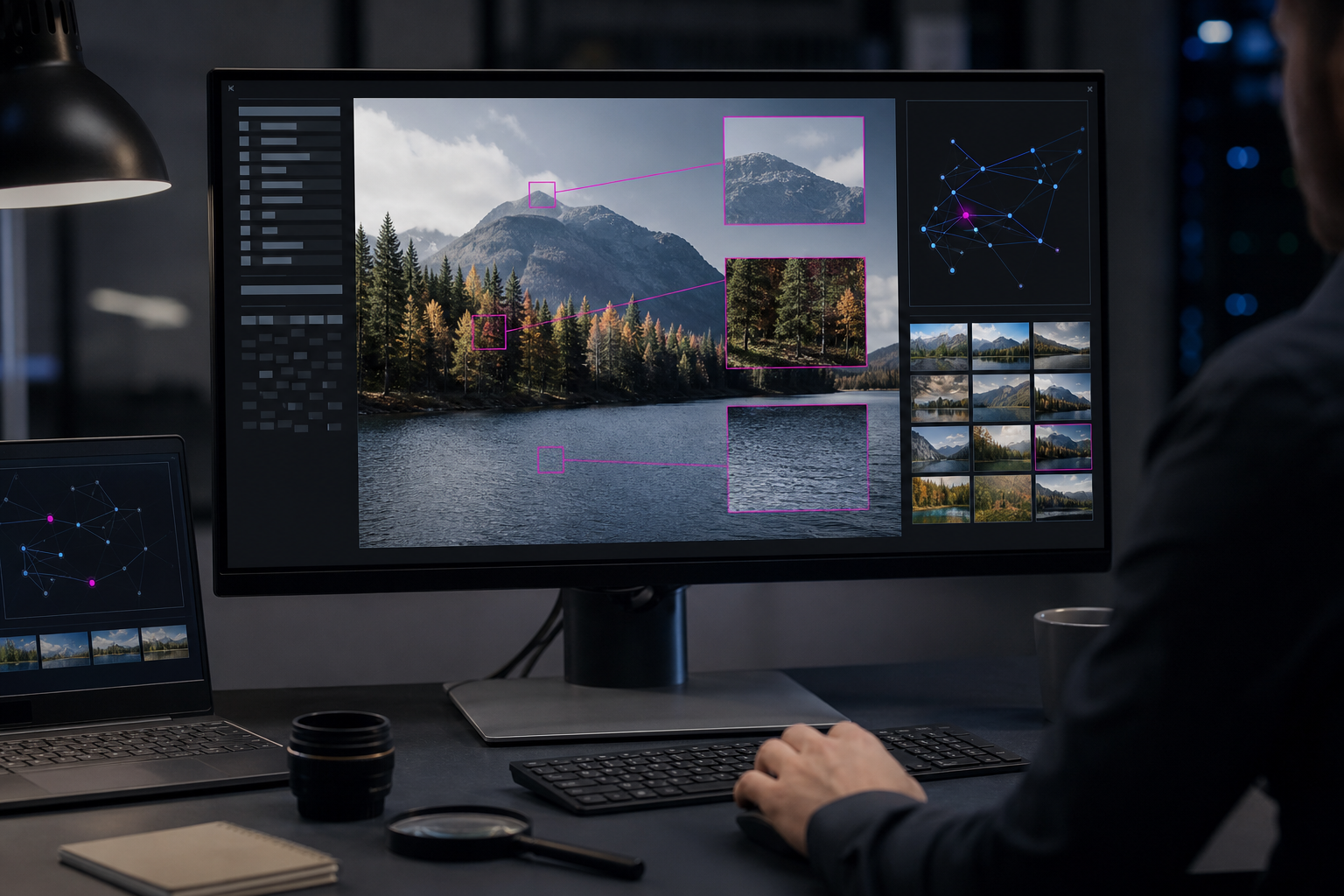
AI-generated images have become more realistic, which makes casual visual guessing unreliable. Distorted hands and impossible shadows still appear, but a polished synthetic image may contain none of those obvious mistakes. Verification works better when it combines visual inspection with source tracing and context.
Start with the claim, not the pixels
Ask where the image came from and what it is supposed to show. Is it attached to a current event, presented as evidence, or simply used as an illustration? A dramatic claim from an unknown account deserves more scrutiny than artwork clearly labeled as synthetic.
Look for the earliest available version. Reposts often remove captions and context. A reverse-image search may reveal that the picture appeared earlier with a different description or was published by its creator as an AI experiment.
Inspect details carefully
Zoom into areas where visual systems commonly struggle: repeated patterns, small objects, reflections, text, jewelry, fingers, and the boundaries between objects. Look for inconsistent perspective, lighting that changes without a reason, or background elements that blend together.
These signs are clues, not proof. Real photographs can contain blur, compression, unusual reflections, and editing artifacts. AI tools can also correct many of their earlier weaknesses.
Check metadata and provenance
An original file may contain information about the camera, editing software, or creation process. Missing metadata does not prove that an image is synthetic because social networks and messaging apps often remove it. Present metadata can also be altered.
Some publishers and tools attach signed provenance information that records how a file was created or edited. When available and valid, this is stronger evidence than a visual hunch. It still needs to be interpreted carefully: an edited photograph is not necessarily deceptive, and a file without provenance is not automatically fake.
Use detection tools cautiously
Automated AI-image detectors estimate likelihood; they do not deliver a guaranteed verdict. Results can change after an image is resized, compressed, or edited. Different detectors may disagree.
Use them as one signal among several. Avoid accusing a creator based only on a percentage from an unknown tool, especially when the original file is unavailable.
Verify important images through independent evidence
For newsworthy claims, search for other photographs, video, official statements, location details, or reports from credible observers. Check whether weather, landmarks, shadows, and timing fit the claim. Independent evidence is often more useful than trying to identify the image generator.
The practical goal is not to label every unusual picture as real or fake. It is to determine whether the image is reliable enough for the purpose at hand. Source history, context, provenance, and corroboration provide a stronger answer than guessing from appearance alone.