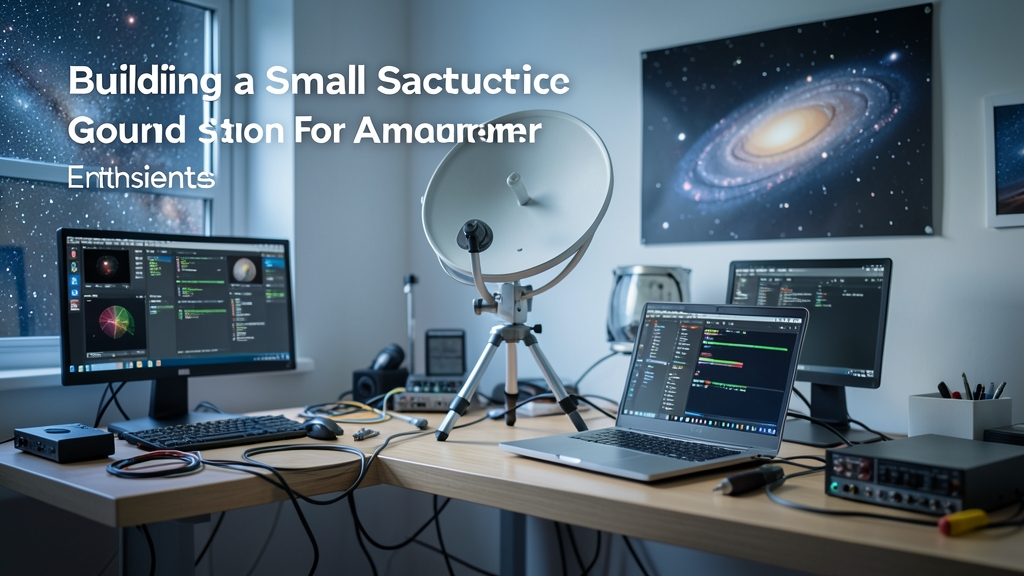
Low‑Earth orbit satellites are increasingly accessible to the public, thanks to open‑source software and affordable radio equipment. A small ground station lets hobbyists receive telemetry, images, or other data streams directly. This guide walks you through the key steps to build a functional, compliant setup without breaking the bank.
1. Choose the Right Frequency Band
Low‑Earth orbit satellites typically use U‑HF (400–450 MHz) or S‑band (2–4 GHz). U‑HF is cheaper and simpler, but offers lower data rates. S‑band requires a higher‑gain dish and a more precise tuner. Select the band based on the satellites you wish to track and your budget.
2. Select and Prepare the Antenna
For U‑HF, a simple 4‑element dipole or a 2‑meter loop will suffice. For S‑band, a 0.5‑meter to 1‑meter parabolic dish is common. Mount the antenna on a stable tripod or a dedicated mast. Ensure the feedline is low‑loss and properly shielded. Use a polarization match (horizontal for U‑HF, circular for many S‑band payloads).
3. Acquire the Receiver and Signal Processing Chain
A software‑defined radio (SDR) such as a USRP or a low‑cost RTL‑SDR can serve as the front end. Connect the antenna feedline to the SDR via an appropriate balun or coaxial adapter. Use open‑source software like Gnuradio or Gpredict to demodulate and decode the satellite signal. For more advanced users, a dedicated satellite receiver (e.g., the RockBlock or the CubeSat ground station kit) can simplify the process.
4. Set Up Tracking and Timing
Satellites move quickly across the sky; accurate tracking is essential. Use a GPS‑disciplined oscillator to provide a stable 10 MHz reference for the SDR, ensuring frequency accuracy. Pair the SDR with a motorized mount or a simple azimuth‑altitude tracker. For a DIY approach, a stepper motor controlled by a Raspberry Pi can follow predicted ephemeris data from the Gpredict software.
5. Understand and Follow Regulations
Operating a ground station requires compliance with national and international regulations. In many countries, U‑HF and S‑band are allocated for amateur use, but you must register your station with the relevant authority (e.g., FCC in the U.S., Ofcom in the U.K.). Avoid transmitting on frequencies reserved for other services and respect power limits. Keep a log of all transmissions for audit purposes.
Practical recommendation
A small satellite ground station is a rewarding project that bridges radio engineering, software, and space science. By selecting the appropriate frequency band, assembling a suitable antenna, using an SDR, and adhering to regulatory guidelines, hobbyists can receive real‑time data from orbiting satellites. Start with a U‑HF setup to master the basics, then upgrade to S‑band as experience and budget grow.